Custom operational software for manufacturers Binghamton, NY
You're a manufacturer with a spreadsheet that runs operations.
It might track delivery dates, production schedules, inventory, or the next step in a job. Your team depends on it. Keeping it up to date is inefficent.
contextFound transforms those load-bearing spreadsheets into tools built around your workflow.
Tell me about one process. Afterward, I'll send you a short brief of what a dedicated solution looks like, with or without us implementing it.
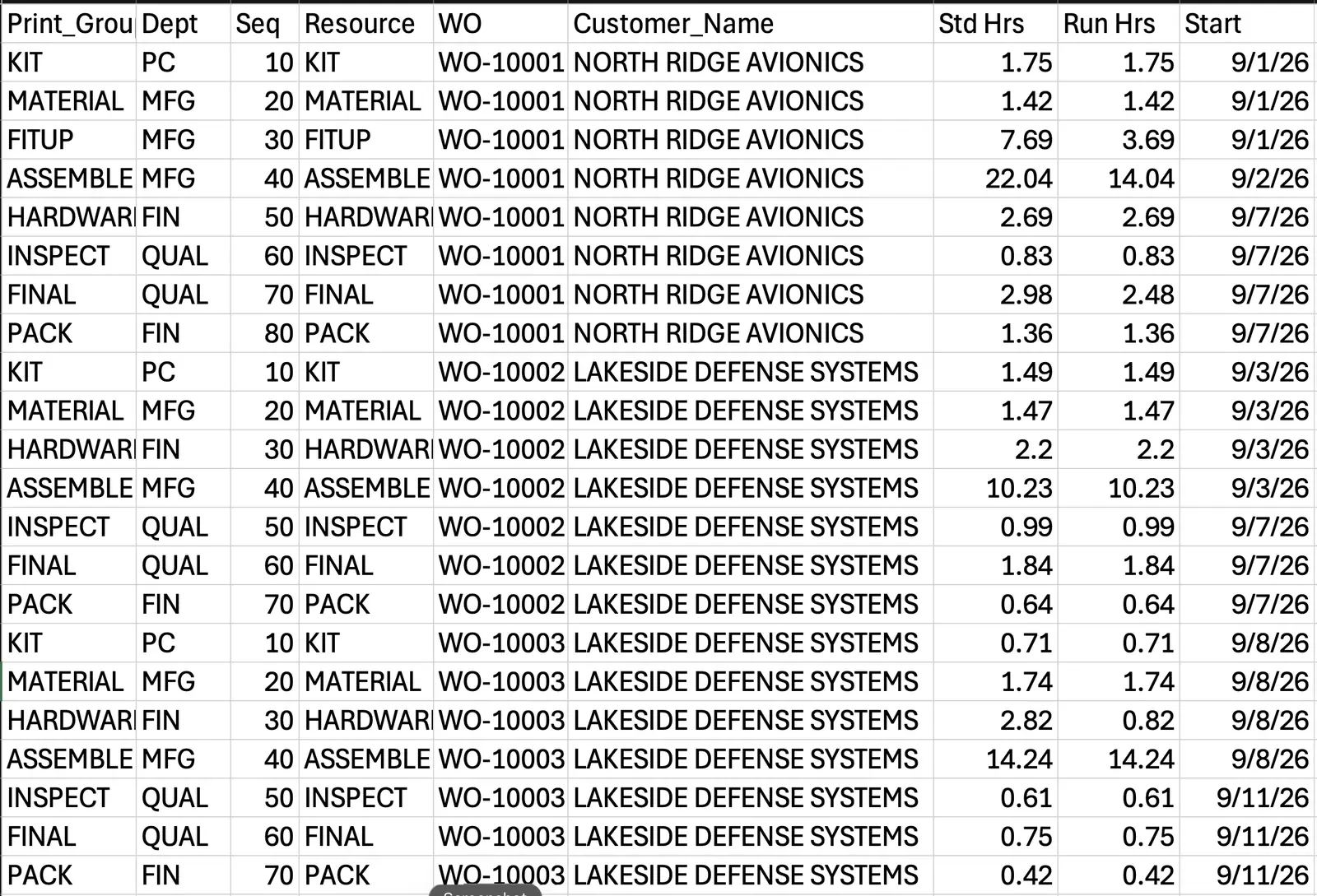

The spreadsheet the schedule lives in The tool built around the workflow
01 The pattern
It started as a practical solution.
Someone just needed a way to get their work done.
You might even have an ERP system, but this spreadsheet has become the record of authority for some portion of your operations.
Over time, updates and imports become manual. Versions get out of sync between team members (or worse, lost). Standard values aren't enforced, breaking formulas. A whole palette of color coded meaning creeps in ("is it red or dark red important?")
- Unofficial record of authority.
- Status and Visibility.
- Gathering input from the team.
Usually there's a keeper of the spreadsheet. When they're out, things get messy.
02 The answer
What answers would increase revenue?
- Which orders are at risk this week?
- What are we past due on?
- What is line-stopping for our customer?
- Which deliveries drive new business?
A tool built for the workflow can bring the relevant information together, apply the rules your team uses, and surface only what needs attention.
Tools should be built for the people doing the work. In the process you already have.
03 Product example
Here's one example: getting from order data to a delivery plan.
You have a hot order. It may be behind. The customer starts asking...
"Where are my parts?"
A proper tool brings order information, remaining operations, and timing assumptions into one view. Maybe it's shipping or inventory that needs tracked most.
Operations Delivery Tracker Demonstration data
- Order
- WO-10004 B2002
- Remaining work
- 99 hrs
- Start
- Sep 01
- Promise date
- Sep 13
- Projected date
- Sep 11 2 days early
| Operation | Hours | Schedule |
|---|---|---|
| 10 KIT | 3 | |
| 20 MATERIAL | 4 | |
| 30 FITUP | 10 | |
| Component B2002/sub01 | No hours | |
FITUP has what it needs on the day it needs it. |
||
| 40 ASSEMBLE | 64 | |
| 50 HARDWARE | 13 | |
| 60 INSPECT | 7 | |
| 70 FINAL | 3 | |
| 80 PACK | 4 | |
The gantt view accounts for the subcomponent availability.
That's the kind of change contextFound focuses on: taking a specific operational question and building a useful tool around it.
04 Our Process
We start with one workflow.
-
01
Look at how the work happens today
Where the current tools fall short, and what a useful first improvement would be.
-
02
Define a focused scope, then build an early version
For the people who will use it. Their feedback helps us catch the details a specification can miss.
-
03
Work through the practical questions
Accuracy, exceptions, access, backups, and ongoing support, before your operation depends on the tool.
-
04
Fit it to the systems you already have
Sometimes the right answer is a small tool connecting the gaps.
05 How it's built
AI-powered development doesn't have to mean an AI-powered solution.
We use AI heavily to build: faster, and at a cost that makes a custom tool worth considering in the first place.
That doesn't mean the tool your team runs on is guessing. For most operational work you want the same rules producing the same answer every time, so the number on the screen is one you can repeat in a meeting and defend to a customer.
We do build AI into solutions where it genuinely earns its place: reading messy inbound emails, pulling data out of PDFs, drafting a schedule for a person to approve. Where it doesn't, we leave it out.
06 Who you'll talk to
You'll be talking with me.

I'm Jason Gardner, founder of contextFound. My background combines industrial and systems engineering, hands-on production experience, and software development.
I'm interested in how the work actually gets done: the handoffs, the checks, the exceptions, and the things people have learned to work around.
You know your business. I bring manufacturing experience and a fresh set of questions. Sometimes that outside perspective is useful before we build anything.
- Engineering
- Industrial and systems engineering
- Operations
- Hands-on production experience
- Build
- Software development
07 Your information
We can talk about the process without exposing your business.
You don't need to send customer lists, pricing, drawings, or production records to start a conversation.
We can work from a description, a blank template, or anonymized sample data. If an NDA needs to come first, let's arrange that.
- A description in your own words
- A blank template
- Anonymized sample data
- An NDA first, if you need one
08 The 20-minute offer
Give me 20 minutes and a workflow that's harder than it should be.
Tell me what it needs to accomplish, who relies on it, and where the work gets difficult.
Afterward you receive a written Workflow Opportunity Brief
- The scope of the current problem
- Root cause challenges to your current solution
- What an ideal future state could look like
- Where AI development or solution might help
The report is entirely yours - whether you have contextFound build your better future or not.
There's no obligation to commission a build.
It doesn't have to be this hard.
Book a 20-minute conversationNo preparation required. Start by telling me what's getting in the way.
- 20 minutes
- A conversation, not a sales pitch
- Respectful of sensitive information